
 EN




Tea Bag Packing Machine Cost Breakdown: What Buyers Should Know Before Investing
Introduction
For businesses entering or expanding in the tea packaging industry, understanding the real tea bag packing machine cost is about much more than comparing quotations from different suppliers. A packaging machine is a long-term production asset, and the lowest purchase price does not always translate into the lowest operating cost.
Whether you're a restaurant chain launching a private-label tea line, a food delivery company adding retail beverage products, a packaging distributor looking for reliable equipment, or an importer sourcing machinery for overseas customers, every purchasing decision should be based on the total cost of ownership rather than the machine price alone.
Over the last few years, the market has become increasingly complex. Automation has become more affordable, demand for sustainable packaging continues to grow, and food safety standards are tightening across many countries. At the same time, buyers are expecting greater flexibility—machines that can process multiple bag styles, work with compostable materials, and integrate easily into existing production lines.
Understanding what drives tea bag machine price differences can help businesses avoid costly mistakes and choose equipment that delivers long-term value instead of short-term savings.
Industry Background
Tea remains one of the world's most popular beverages, but the way it is packaged has changed significantly.
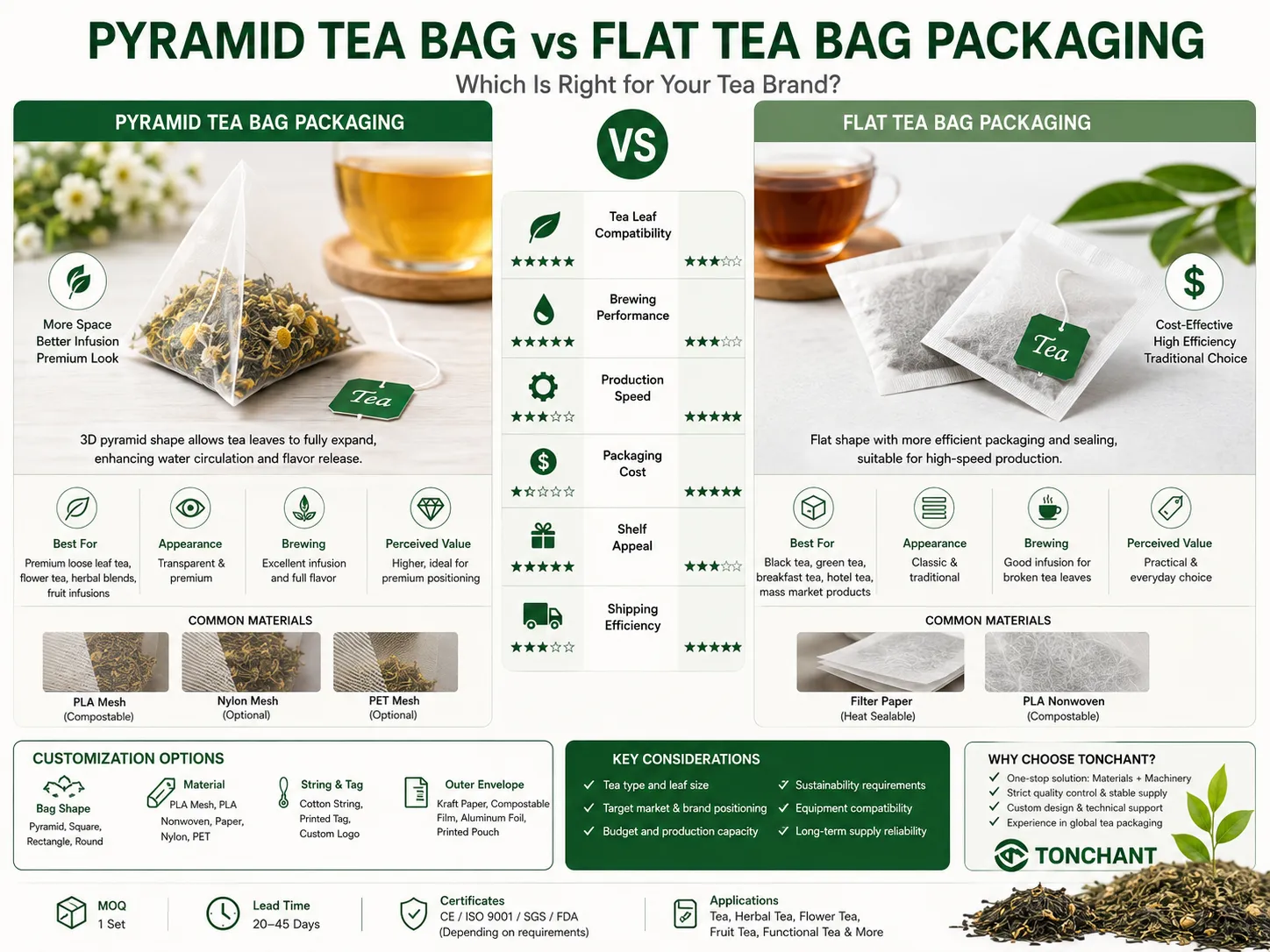
Traditional black tea packed in flat filter paper bags still represents a large share of the market, yet premium teas are growing faster than many conventional categories. Whole-leaf tea, herbal infusions, fruit blends, and wellness products are increasingly packaged in pyramid tea bags that require more advanced equipment and different filter materials.
As consumer expectations evolve, packaging has become part of the product experience. Buyers are paying attention not only to freshness and food safety, but also to brewing performance, sustainability, and visual presentation.
For manufacturers, this shift has changed equipment requirements as well.
Today's packaging lines often need to support:
-
Flat tea bags
-
Pyramid tea bags
-
Inner and outer envelope packaging
-
Printed tags and strings
-
Date coding
-
Compostable filter materials
That additional flexibility naturally affects the overall tea packaging machine cost.
Instead of purchasing a single-purpose machine designed for one product, many companies now prefer equipment that can adapt as their product portfolio grows.
Current Market Trends
Several developments are reshaping the global tea packaging equipment market.
Automation Is Becoming Accessible to Medium-Sized Businesses
Only a few years ago, fully automatic packaging systems were mainly found in large multinational tea factories.
Today, many regional tea brands and contract packers are investing in automation because labor has become both more expensive and harder to recruit. Compact automatic machines have made it possible for smaller businesses to improve production efficiency without building a massive manufacturing operation.
For buyers, this means there are more equipment choices than ever before—but also more variation in quality.
Sustainable Packaging Is Influencing Equipment Design
Environmental regulations and retailer requirements have accelerated the adoption of compostable tea bag materials.
Across Europe, supermarket chains increasingly encourage suppliers to replace petroleum-based mesh with PLA materials. Similar trends are appearing in North America, while many Asian exporters are upgrading production lines to satisfy overseas customers.
Processing biodegradable materials isn't simply a matter of changing the filter roll. PLA mesh and PLA nonwoven respond differently to heat than conventional materials, so sealing systems often require more precise temperature control.
Machines designed specifically for sustainable materials may carry a higher upfront cost, but they usually provide more stable production over time.
Digital Technology Is Improving Production Efficiency
Modern packaging equipment has become much smarter.
Touchscreen PLC systems, production monitoring, automatic error detection, and remote diagnostics are now common features instead of expensive upgrades.
For manufacturers operating multiple production shifts, these functions help reduce downtime and simplify maintenance.
Many distributors report that customers now ask about software capabilities almost as often as mechanical specifications.
Global Supply Chains Continue to Shift
China remains one of the largest suppliers of tea packaging machinery, while European manufacturers continue to lead the high-end industrial equipment segment.
North American buyers have become increasingly selective, paying closer attention to spare parts availability, after-sales service, and supplier responsiveness rather than focusing only on the initial quotation.
This shift reflects a broader understanding that machine reliability often matters more than a small difference in purchase price.
Key Drivers Behind the Trend
Understanding why the tea bag packing machine cost continues to evolve requires looking at several industry-wide factors.
Labor Costs Continue to Rise
Automation has become one of the most effective ways to offset increasing labor expenses.
A business producing several hundred thousand tea bags every month can often recover its investment through improved productivity, reduced labor requirements, and more consistent filling accuracy.
For many manufacturers, automation is no longer viewed as a luxury—it has become a practical necessity.
Premium Tea Continues to Grow
Premium tea products demand premium packaging.
Whole leaves, flower petals, dried fruit, and herbal ingredients require gentle handling and precise weighing systems. Packaging these products also calls for stronger sealing performance and higher-quality filter materials.
As equipment becomes more sophisticated, the tea bag machine price naturally reflects those additional capabilities.
Food Safety Standards Are Becoming More Demanding
Manufacturers exporting to international markets face stricter hygiene requirements than ever before.
Modern equipment commonly incorporates:
-
SUS304 stainless steel product-contact parts
-
Hygienic machine structures
-
Easy-clean designs
-
Improved dust collection systems
Although these features increase manufacturing costs, they also help businesses meet customer audits and regulatory inspections.
Production Flexibility Has Become a Competitive Advantage
A growing number of tea brands offer seasonal products, limited editions, and customized private-label programs.
Instead of operating separate production lines, manufacturers increasingly prefer machines capable of handling different bag sizes, filter materials, and packaging formats with minimal changeover time.
That flexibility adds value far beyond the purchase price.
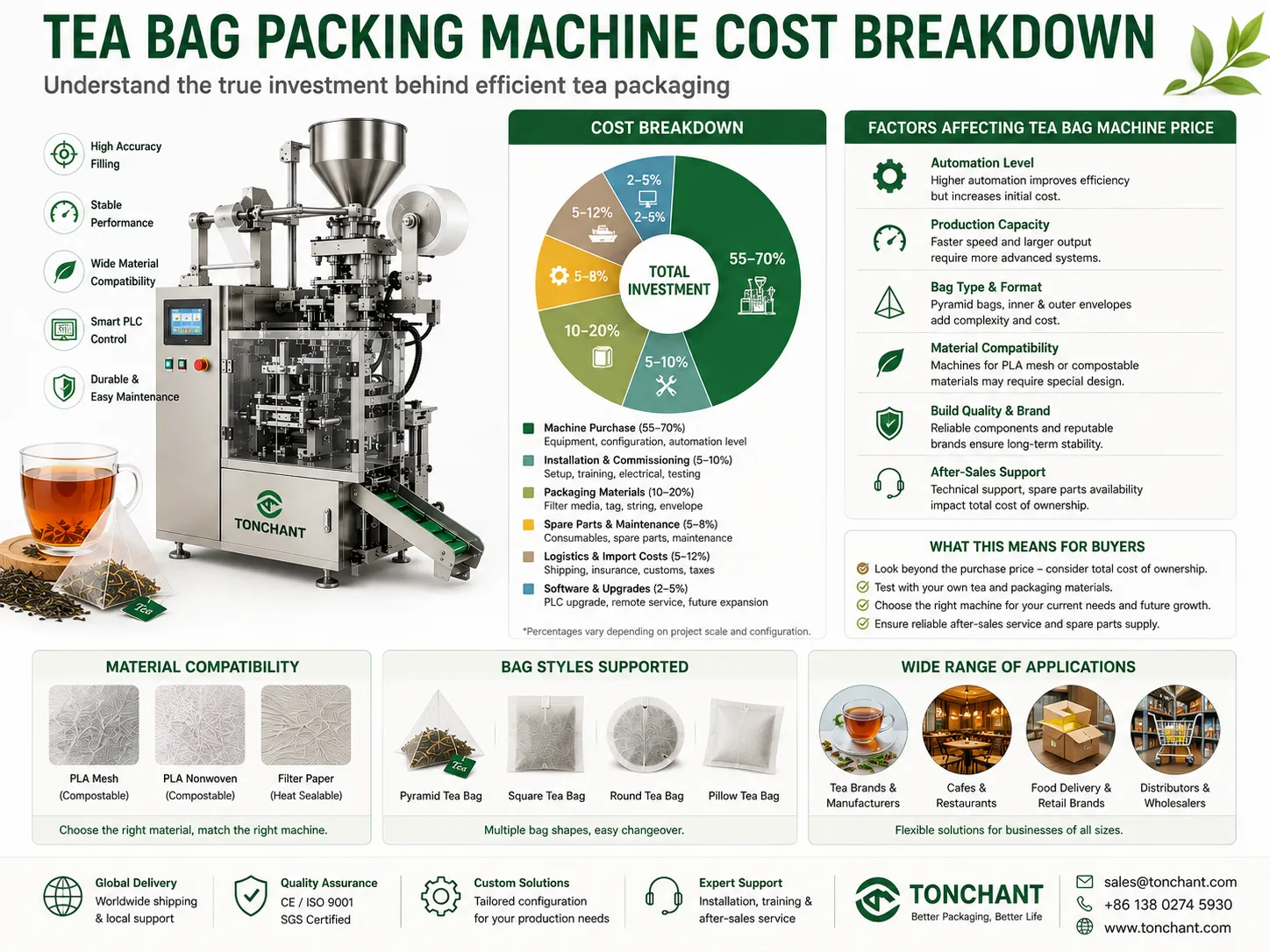
Understanding the Real Cost of a Tea Bag Packing Machine
One of the biggest misconceptions among first-time buyers is that the quoted machine price represents the total investment.
In reality, equipment cost is only one part of the project.
| Cost Component | Typical Share of Total Investment | What Buyers Should Evaluate |
|---|---|---|
| Machine Purchase | 55–70% | Automation level, production speed, configuration |
| Installation & Commissioning | 5–10% | Factory layout, electrical requirements, operator training |
| Packaging Materials | 10–20% | Filter media, strings, tags, outer envelopes |
| Spare Parts & Maintenance | 5–8% | Availability, replacement intervals, technical support |
| Shipping & Import Costs | 5–12% | Ocean freight, customs duties, insurance, inland transport |
| Software & Future Upgrades | 2–5% | PLC updates, remote diagnostics, production expansion |
Looking at the complete lifecycle cost often provides a much clearer picture than comparing quotations line by line.
For example, a machine priced slightly higher may consume less filter material, require fewer maintenance visits, and achieve better filling accuracy. Over several years of production, those operational savings can outweigh the difference in purchase price.
Challenges Facing the Industry
Despite strong demand, buyers continue to face several practical challenges.
Comparing Equipment Isn't Always Straightforward
Two suppliers may advertise similar production speeds, yet the machines can perform very differently in actual production.
Factors such as sealing quality, weighing accuracy, and long-term reliability rarely appear in a specification sheet.
Experienced buyers usually request production videos or live factory demonstrations before making a final decision.
Material Compatibility Is Often Overlooked
This issue becomes especially important for businesses planning to use sustainable packaging materials.
A machine that seals conventional filter paper perfectly may produce inconsistent results when running PLA mesh or compostable nonwoven fabric.
Before signing a purchase agreement, buyers should ask suppliers to test the machine using the exact materials and tea blend intended for commercial production.
After-Sales Support Can Affect Long-Term Costs
A production line is only as reliable as the service supporting it.
Importers frequently discover that inexpensive machines become costly when spare parts are unavailable or technical assistance is slow.
Reliable after-sales service reduces downtime, protects production schedules, and helps maintain customer confidence.
Regulatory Requirements Continue to Evolve
Europe
The European Union continues advancing sustainability policies through initiatives such as the Packaging and Packaging Waste Regulation (PPWR). Tea producers increasingly seek machinery compatible with recyclable and compostable materials while ensuring traceability throughout production.
North America
Food manufacturers are balancing strict food-contact regulations with growing retailer expectations for environmentally responsible packaging. Many companies are upgrading packaging lines to improve consistency while reducing waste.
Asia
Manufacturers across China, Vietnam, India, and Southeast Asia continue investing in automation to support export markets. International certifications and consistent production quality remain key purchasing priorities for overseas buyers.
What This Means for Buyers
Every buyer enters the market with different priorities.
A restaurant chain launching a premium tea collection may not need the fastest production line available. Instead, flexibility could be far more valuable. Being able to package several tea varieties on one machine allows new products to reach the market without additional equipment investment.
A packaging distributor faces a different challenge. Customers rarely ask only about machine specifications—they also need reliable packaging materials, technical support, and replacement parts. Offering a complete solution often creates stronger customer relationships than selling equipment alone.
Importers should also consider local service capabilities. Machines purchased overseas inevitably require maintenance during their operating life. Choosing a supplier with responsive technical support and readily available spare parts can significantly reduce long-term operating costs.
Sustainable packaging buyers should think beyond marketing claims. It's worth confirming that the machine has already been running commercial production with PLA mesh or compostable filter materials, rather than simply being described as "compatible."
Whenever possible, request production samples using your own tea blend. Watching the equipment package your actual product provides valuable information about filling accuracy, sealing quality, production speed, and finished bag appearance.
Insights from Tonchant Pack
At Tonchant Pack, we've worked with tea brands, machinery distributors, and packaging importers serving markets across Europe, North America, and Asia. One trend we've consistently observed is that purchasing decisions have become more strategic.
Several years ago, most conversations focused almost entirely on tea bag machine price. Today, buyers are asking different questions. They want to know how easily a machine switches between bag styles, whether it performs consistently with PLA mesh, how quickly spare parts can be supplied, and what level of technical support is available after installation.
Our engineering team also sees a common challenge among first-time buyers. Many compare equipment using specification sheets alone. Once we evaluate the customer's tea characteristics, packaging materials, production targets, and future expansion plans, the most suitable solution often differs from the one they initially requested.
Because Tonchant Pack supplies both packaging materials and compatible machinery, we can test filter media and machine settings together before shipment. That approach helps reduce compatibility issues during installation and gives customers greater confidence when production begins.
Future Outlook
The tea packaging equipment industry is expected to become even more technology-driven over the coming years.
Artificial intelligence is beginning to support predictive maintenance, allowing manufacturers to identify potential issues before unexpected downtime occurs.
Machine vision systems are becoming more affordable and are increasingly used to inspect bag sealing, label placement, and filling accuracy in real time.
Sustainability will continue to shape equipment development. Future packaging machines are likely to support a wider range of compostable materials while improving energy efficiency and reducing production waste.
At the same time, flexible manufacturing will become increasingly important. Buyers are looking for equipment that can adapt to changing product lines instead of requiring entirely new production systems for every packaging format.
Frequently Asked Questions
What is included in the tea bag packing machine cost?
The tea bag packing machine cost usually covers the machine, standard accessories, operating manuals, and basic factory testing. Installation, shipping, customs duties, packaging materials, and optional automation features are typically quoted separately.
Why does the tea bag machine price vary so much?
The tea bag machine price depends on production speed, automation level, bag style, weighing technology, packaging material compatibility, customization requirements, and control system configuration.
Is a more expensive machine always the better choice?
Not necessarily. Reliability, maintenance requirements, filling accuracy, material waste, technical support, and production flexibility often have a greater impact on long-term profitability than the initial purchase price.
Should buyers request production testing?
Absolutely. Running your own tea blend and packaging material through the machine before shipment provides valuable insight into sealing quality, production stability, and finished product appearance.
Which certifications are commonly required?
Most international buyers request documentation such as CE certification, ISO 9001 quality management certification, SGS inspection reports, and food-contact compliance documentation where applicable.
How can importers reduce total ownership costs?
Working with suppliers that provide operator training, technical documentation, responsive after-sales support, and dependable spare parts availability can significantly reduce maintenance expenses and production interruptions over the equipment's lifespan.
Conclusion
Understanding the true tea bag packing machine cost requires looking well beyond the quotation on the first page of a proposal. Equipment configuration, automation level, packaging material compatibility, installation, maintenance, regulatory compliance, and long-term operating efficiency all influence the overall investment.
As the tea industry continues moving toward premium products, sustainable packaging, and smarter manufacturing, buyers are placing greater value on flexibility and reliability than ever before. Machines capable of processing compostable materials, adapting to multiple bag formats, and integrating with digital production systems are increasingly becoming the preferred choice for manufacturers worldwide.
For restaurant chains, distributors, wholesalers, importers, and sustainable packaging buyers, successful equipment sourcing begins with understanding production goals rather than simply comparing prices. Evaluating total ownership costs, verifying performance through real production trials, and partnering with experienced suppliers can help reduce operational risk while creating a stronger foundation for long-term business growth. In today's competitive market, the smartest investment isn't necessarily the least expensive tea packaging machine cost—it's the one that delivers consistent performance, reliable support, and lasting value throughout its service life.