
 EN
EN



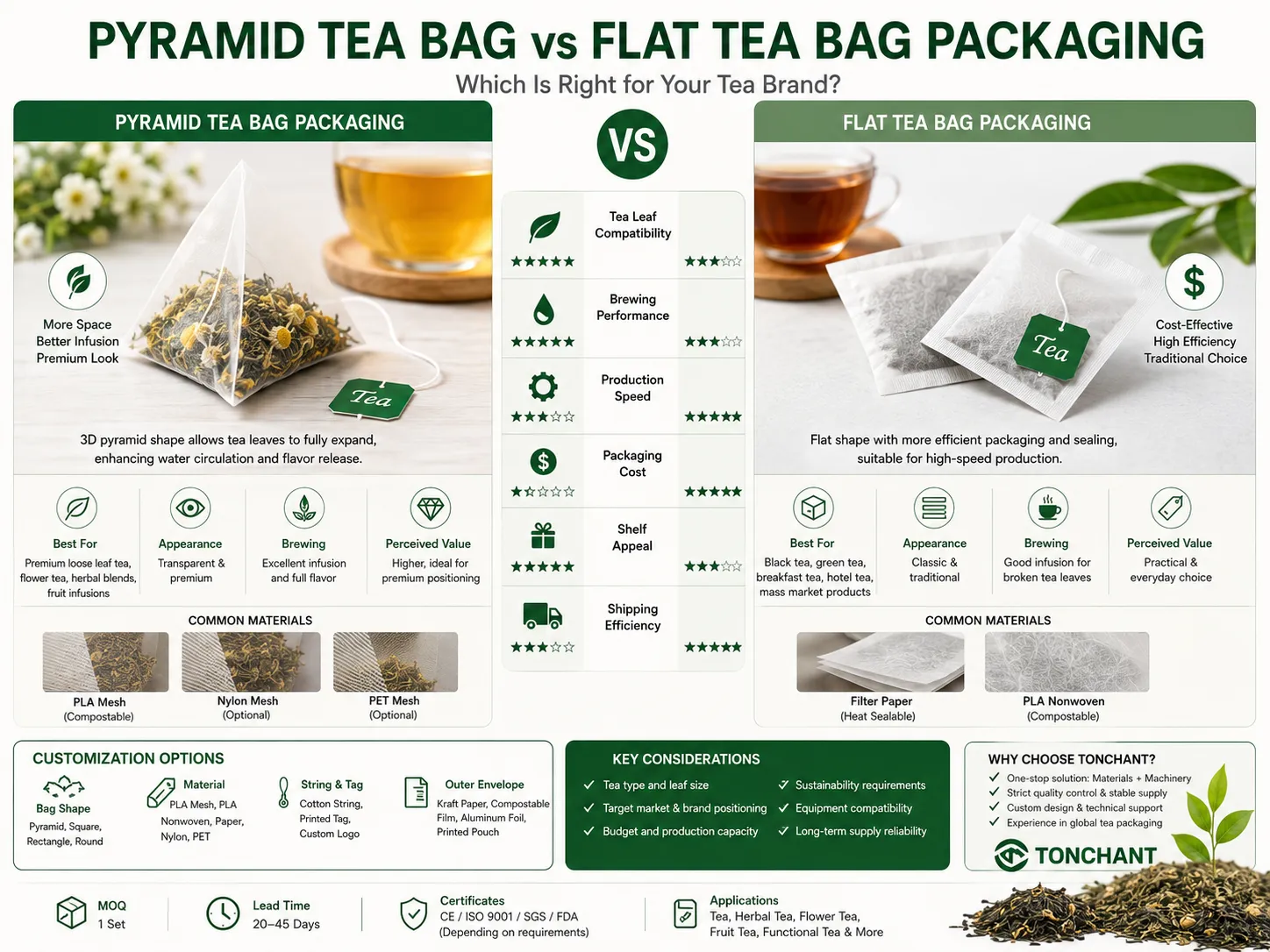
Pyramid Tea Bag vs Flat Tea Bag Packaging: Which Option Is Right for Your Tea Brand?
Walk through the tea aisle of any supermarket or browse a premium tea boutique online, and you'll notice one thing immediately—tea packaging has evolved. Traditional flat tea bags still dominate everyday tea products, while elegant pyramid tea bags have become a hallmark of premium brands.
For tea manufacturers, private-label companies, importers, and distributors, choosing between pyramid tea bag packaging and flat tea bag packaging is more than a design decision. It influences production efficiency, material costs, brewing performance, brand positioning, and even how consumers perceive product quality.
There isn't a universal "better" option. The best choice depends on your tea, your customers, and your business strategy.
This guide compares both packaging styles from a buyer's perspective, combining technical knowledge with practical sourcing advice to help you make a confident decision.
Understanding the Two Packaging Styles
Before comparing features, it's worth understanding why these two formats exist in the first place.
What Is Pyramid Tea Bag Packaging?
Pyramid tea bag packaging uses a three-dimensional tetrahedral bag that creates additional space inside the filter material. Instead of compressing the tea leaves into a thin pouch, the pyramid shape allows the ingredients to move freely while brewing.
This style has become particularly popular among specialty tea brands because it showcases whole leaves, flower petals, fruit pieces, and herbs through transparent mesh.
You'll commonly find pyramid bags in:
-
Premium loose-leaf tea
-
Organic tea collections
-
Herbal infusions
-
Flower tea
-
Fruit tea
-
Wellness blends
-
Luxury gift boxes
For brands selling quality rather than quantity, presentation matters just as much as taste.
What Is Flat Tea Bag Packaging?
Flat tea bag packaging is the classic tea bag most consumers recognize.
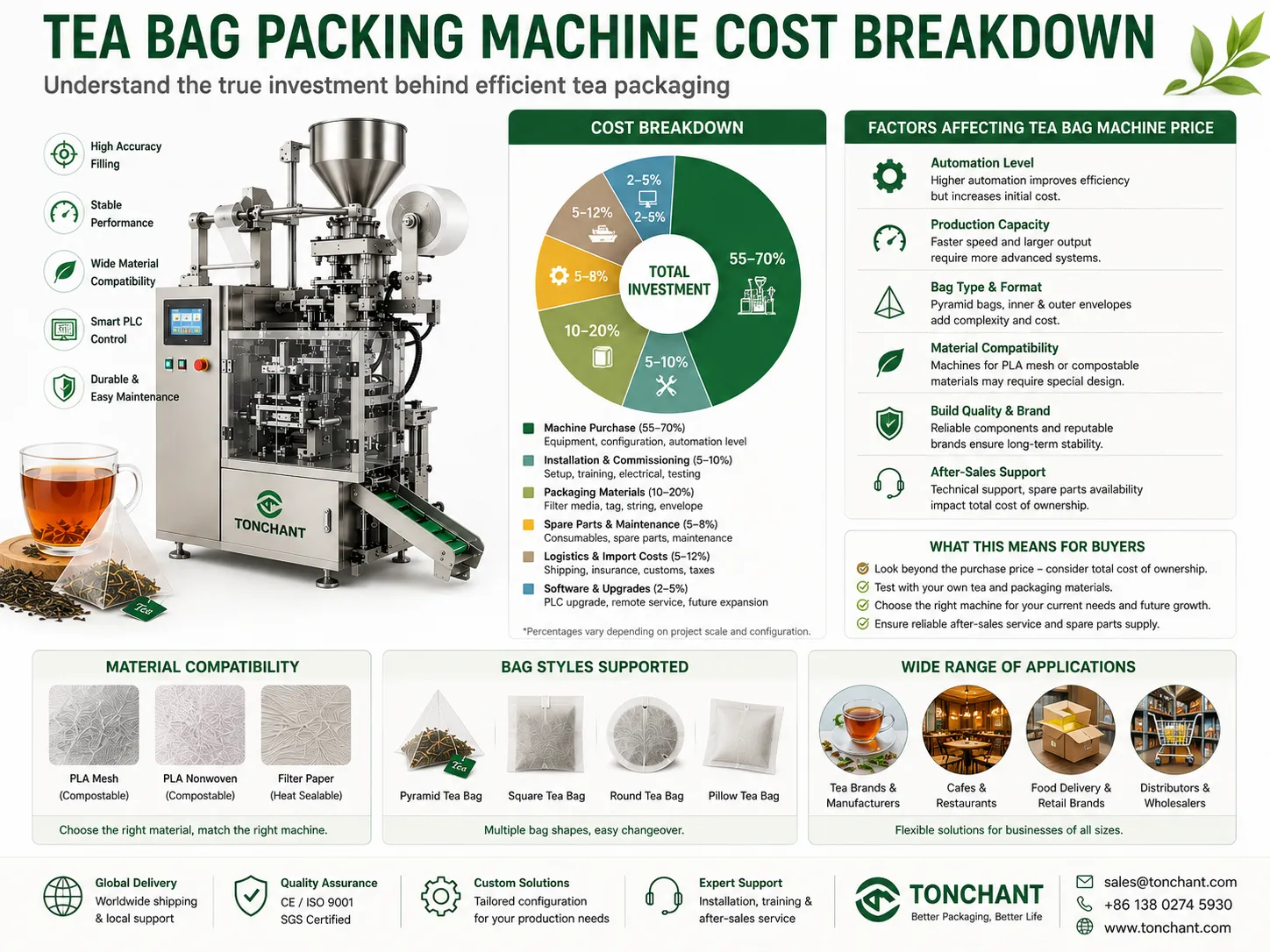
Available in square, rectangular, round, and pillow shapes, flat tea bags remain the global standard for large-scale tea production.
They're commonly used for:
-
Black tea
-
Green tea
-
Breakfast tea
-
Hotel tea
-
Office tea
-
Catering products
-
Supermarket private-label brands
While they may look simpler, flat tea bags continue to account for the majority of tea bag production worldwide because they offer excellent production efficiency and competitive packaging costs.
The Biggest Difference Isn't the Shape
Many buyers initially focus on appearance, but experienced tea manufacturers usually begin somewhere else—the tea itself.
Whole-leaf tea behaves very differently from finely cut black tea.
Premium oolong, white tea, or blooming flower blends need room to open during brewing. If they're packed into a thin flat bag, much of their visual appeal and brewing performance is lost.
On the other hand, finely broken breakfast tea extracts flavor quickly regardless of bag shape. In these cases, investing in pyramid bags may increase packaging costs without delivering noticeable value to the end consumer.
This is why experienced buyers rarely choose packaging first. They start by evaluating the product.
Materials Used in Tea Bag Packaging
The filter material has just as much influence on brewing performance as the bag design.
Different tea products require different materials depending on sustainability goals, sealing performance, and machine compatibility.
Materials for Pyramid Tea Bag Packaging
PLA Mesh
PLA mesh has become one of the fastest-growing materials in premium tea packaging.
Made from renewable plant-based resources, it combines transparency with excellent brewing performance while supporting brands that want more environmentally responsible packaging.
Advantages include:
-
Commercially compostable
-
Crystal-clear appearance
-
Excellent water circulation
-
Strong heat sealing
-
Premium shelf presentation
For whole-leaf tea, PLA mesh is now one of the most requested materials in international markets.
Nylon Mesh
For many years, nylon mesh was considered the premium standard because of its strength and clarity.
It remains suitable for:
-
Luxury pyramid bags
-
Specialty blends
-
Decorative tea collections
However, changing consumer expectations have encouraged many brands to transition toward bio-based alternatives.
PET Mesh
PET mesh offers excellent mechanical stability and performs well during high-speed production.
Although not compostable, it remains a practical solution for many commercial packaging projects.
Materials for Flat Tea Bag Packaging
Heat-Sealable Filter Paper
Traditional filter paper remains the most widely used material in flat tea bag packaging.
Its popularity comes down to three simple reasons:
-
Reliable production
-
Competitive cost
-
High-speed packaging
For everyday tea products, it continues to be one of the most economical solutions available.
PLA Nonwoven Fabric
As sustainability becomes a purchasing priority, more brands are switching to PLA nonwoven fabric.
Compared with conventional filter paper, it offers:
-
Plant-based raw materials
-
Fine particle filtration
-
Good sealing performance
-
Compostable characteristics
Many organic tea companies now specify PLA nonwoven as part of their brand strategy.
Applications
Both packaging styles have their place in today's tea market.
Pyramid Tea Bag Packaging
Typically selected for:
-
Premium loose-leaf tea
-
Flower tea
-
Herbal blends
-
Fruit infusions
-
Wellness products
-
High-end gift collections
Flat Tea Bag Packaging
Frequently used for:
-
Daily drinking tea
-
Black tea
-
Green tea
-
Hotel supplies
-
Catering products
-
Large retail programs
-
Promotional tea products
Advantages of Pyramid Tea Bag Packaging
The popularity of pyramid tea bag packaging isn't simply driven by appearance.
There are genuine functional advantages.
Better Infusion
The additional brewing space allows larger tea leaves to fully expand.
This often produces:
-
Richer aroma
-
Fuller flavor
-
Better extraction
-
Improved customer experience
Premium Shelf Appeal
Consumers increasingly associate pyramid bags with higher-quality tea.
Even before brewing, the transparent mesh allows buyers to appreciate the ingredients inside.
That visual connection can significantly influence purchasing decisions.
Ideal for Whole Ingredients
Large tea leaves, rose buds, chamomile flowers, dried fruit, and herbs maintain their natural appearance inside pyramid bags.
Nothing feels compressed or hidden.
Higher Brand Value
Many specialty tea companies use pyramid packaging as part of their premium positioning.
Rather than competing on price, they compete on presentation and quality.
Advantages of Flat Tea Bag Packaging
Flat bags have remained popular for decades because they solve a different set of business challenges.
Lower Production Cost
They use less filter material and generally require less complex forming systems.
For high-volume production, the savings become significant.
Faster Production
Many flat tea bag machines operate at higher speeds than pyramid systems.
This makes them ideal for:
-
Supermarket suppliers
-
Contract packers
-
High-volume OEM production
Efficient Shipping
Because flat tea bags occupy less space, more finished products fit into each shipping carton.
For exporters, better container utilization can reduce freight costs over time.
Proven Consumer Acceptance
Millions of consumers brew tea from flat bags every day.
For traditional breakfast teas, customers often value consistency and affordability more than premium presentation.
Real Buyer Scenarios
Every packaging project tells a different story.
A European organic tea startup recently approached the market with handcrafted botanical blends featuring whole chamomile flowers and dried citrus slices. Their priority wasn't maximizing production speed—it was creating a product that looked as premium as it tasted. Pyramid tea bag packaging paired with PLA mesh became the obvious choice because customers could immediately see the ingredients through the transparent filter.
Another customer, a private-label supplier serving major supermarket chains, had a completely different objective. Their production exceeded several million tea bags each month, and pricing pressure was intense. They selected flat tea bag packaging using heat-sealable filter paper because it delivered reliable quality while keeping packaging costs under control.
A hotel supplier faced yet another challenge. Their tea selection included English Breakfast, Green Tea, and Earl Grey served in guest rooms worldwide. Compact packaging, fast production, and efficient transportation mattered more than premium aesthetics, making flat tea bags the most practical solution.
These examples highlight an important point: successful buyers don't choose packaging because it's fashionable. They choose packaging that fits their product and market.
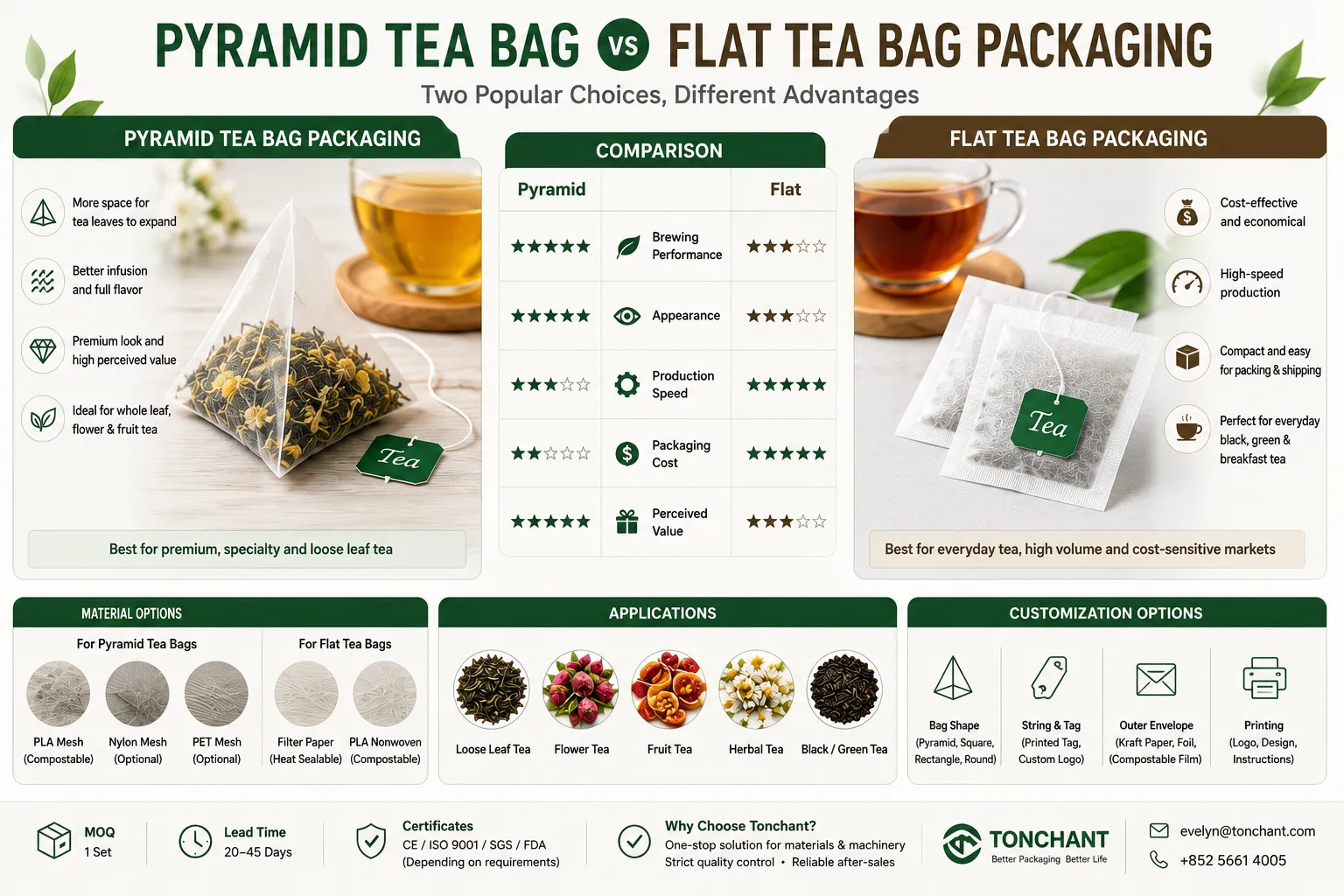 Tea Bag Packaging Comparison
| Feature | Pyramid Tea Bag Packaging | Flat Tea Bag Packaging |
|---|---|---|
| Appearance | Premium and modern | Classic and familiar |
| Brewing Space | Excellent | Limited |
| Whole Leaf Compatibility | Excellent | Moderate |
| Production Speed | Medium | High |
| Material Usage | Higher | Lower |
| Packaging Cost | Higher | Lower |
| Shelf Appeal | Premium | Standard |
| Consumer Perception | Specialty tea | Everyday tea |
| Best Application | Premium products | High-volume production |
Customization Options
Today's packaging equipment offers much more flexibility than many buyers expect.
Popular customization options include:
Bag Style
-
Pyramid
-
Square
-
Rectangle
-
Pillow
-
Round
Filter Materials
-
PLA mesh
-
PLA nonwoven
-
Filter paper
-
Nylon mesh
-
PET mesh
String and Tag
Options include:
-
Cotton string
-
Colored string
-
Printed paper tags
-
Brand logo
-
QR codes
Outer Envelope
Available materials include:
-
Kraft paper
-
Compostable film
-
Aluminum foil laminate
-
Printed flexible packaging
Branding
Tea companies can customize:
-
Product artwork
-
Brewing instructions
-
Batch coding
-
Multilingual printing
-
Promotional graphics
Sourcing Considerations Before You Buy
One mistake many first-time buyers make is comparing suppliers based only on machine price or packaging material cost.
Experienced purchasing teams usually look much deeper.
The first question should be compatibility. A packaging machine may work perfectly with filter paper but produce inconsistent seals when running PLA mesh. Always ask suppliers to provide production samples using the exact materials you intend to purchase.
Technical support is equally important. Packaging equipment represents a long-term investment, so spare parts availability, online troubleshooting, and commissioning support should all be confirmed before placing an order.
Consistency is another factor that's often underestimated. Materials from different suppliers can vary in thickness, sealing performance, and roll tension. Working with a supplier capable of providing both packaging materials and compatible machinery reduces these risks considerably.
Finally, don't overlook future expansion. If your current product line consists of traditional tea bags but you plan to introduce premium collections next year, selecting equipment that can accommodate multiple materials or bag formats may save significant capital later.
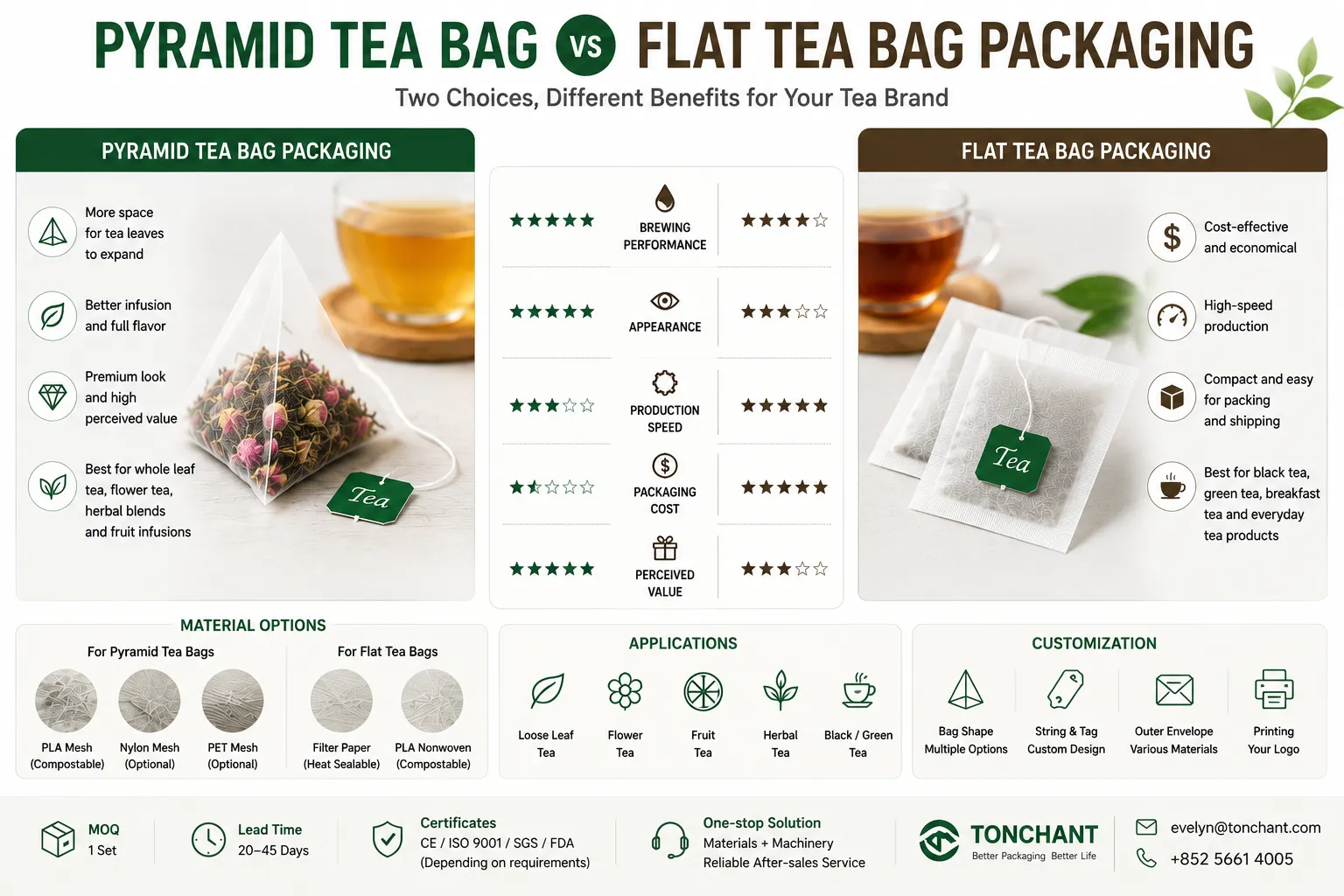 Tonchant's Manufacturing Experience
Over the years, Tonchant has supplied tea packaging materials and machinery to customers ranging from boutique tea companies to large-scale OEM manufacturers.
One trend has become increasingly clear: packaging decisions are changing alongside consumer expectations.
Five years ago, most discussions focused on production speed and cost. Today, sustainability, premium presentation, and packaging differentiation are part of nearly every project conversation.
We've also found that successful packaging projects begin with understanding the tea rather than recommending equipment immediately.
For example, a customer producing premium white tea may require transparent PLA mesh to highlight delicate whole leaves, while another manufacturing finely cut breakfast tea can achieve excellent results using traditional filter paper. Recommending the same solution to both customers would overlook the practical realities of their products.
Because Tonchant supplies both tea bag packaging materials and compatible machinery, our engineering team can evaluate filter media, sealing performance, production capacity, and packaging design together. This integrated approach helps reduce compatibility issues, shortens development time, and provides customers with a more reliable production process.
MOQ
Typical purchasing requirements include:
| Product | Typical MOQ |
|---|---|
| Tea bag packaging machine | 1 set |
| Customized machine | 1 set |
| PLA mesh | 50–500 kg |
| Filter paper | 50–500 kg |
| Customized tags and envelopes | Based on artwork and specifications |
Lead Time
Lead times vary depending on customization and order volume.
| Product | Lead Time |
|---|---|
| Standard packaging machine | 20–30 days |
| Customized machine | 30–45 days |
| Packaging materials | 15–25 days |
| Printed packaging materials | 20–35 days |
Ordering ahead of peak harvest seasons is recommended, particularly for custom printed materials.
Certificates
A reliable packaging supplier should be able to provide relevant documentation, including:
-
CE Certification
-
ISO 9001 Quality Management System
-
SGS Inspection Reports
-
FDA-compliant food-contact materials where applicable
-
RoHS compliance for electrical components
-
Compostability reports for PLA materials when requested
Always verify the certification requirements of your destination market before production begins.
Frequently Asked Questions
Which packaging is better for premium tea?
For whole-leaf, flower, or specialty teas, pyramid tea bag packaging generally delivers better brewing performance and stronger shelf appeal.
Is flat tea bag packaging becoming outdated?
Not at all. Flat tea bag packaging continues to dominate commercial tea production because it remains cost-effective, efficient, and widely accepted by consumers around the world.
Which filter material is the most sustainable?
PLA mesh and PLA nonwoven are among the most popular choices for brands seeking commercially compostable, plant-based packaging solutions.
Does pyramid packaging cost more?
Yes. Pyramid bags require more filter material and specialized forming equipment. However, many premium tea brands recover the additional cost through higher retail pricing and stronger product positioning.
Can one machine produce both pyramid and flat tea bags?
Some advanced packaging systems support interchangeable forming sets, allowing manufacturers to switch between different bag styles. Others are dedicated to a single format, so this should be confirmed before purchasing.
What should buyers evaluate besides price?
Production stability, sealing quality, machine compatibility, material consistency, technical support, spare parts availability, and supplier experience all have a significant impact on the long-term success of a packaging project.
Conclusion
Choosing between pyramid tea bag packaging and flat tea bag packaging is ultimately a strategic business decision rather than a simple packaging preference.
If your brand focuses on specialty teas, premium ingredients, and elevated consumer experiences, pyramid bags offer outstanding brewing performance, strong visual appeal, and greater perceived value. For businesses serving supermarkets, hotels, food-service channels, or large private-label programs, flat tea bags remain an efficient and economical solution that continues to perform exceptionally well at scale.
The most successful buyers begin with their product, understand their target customer, and then select the packaging format that best supports their long-term brand strategy. By combining the right materials, compatible equipment, and an experienced manufacturing partner, tea companies can build packaging solutions that not only protect the product but also strengthen their position in an increasingly competitive global tea market.