
 EN
EN


Coffee Powder Packaging Machine Buying Guide: A Practical Guide for B2B Buyers
Introduction
Buying a coffee powder packaging machine is a bigger decision than simply comparing machine prices.
For a small coffee roaster, the priority might be keeping the investment manageable while improving packing consistency. A restaurant chain may care more about stable output and reducing labor. For a distributor or wholesaler, flexibility can be the deciding factor because different customers may require different bag sizes, materials, and filling weights.
Coffee itself also makes packaging more complicated than it first appears. Ground coffee varies in density, particle size, and flowability. Freshly roasted coffee releases CO₂, and fine coffee particles can create dust around the filling area. A machine that performs well with one coffee product may require different settings or components for another.
That is why experienced buyers should evaluate the complete packaging process rather than choosing equipment based only on advertised speed.
This guide looks at what a coffee powder packaging machine actually does, where it fits into commercial coffee production, and what to consider before requesting a quotation or placing an order.
 What Is a Coffee Powder Packaging Machine?
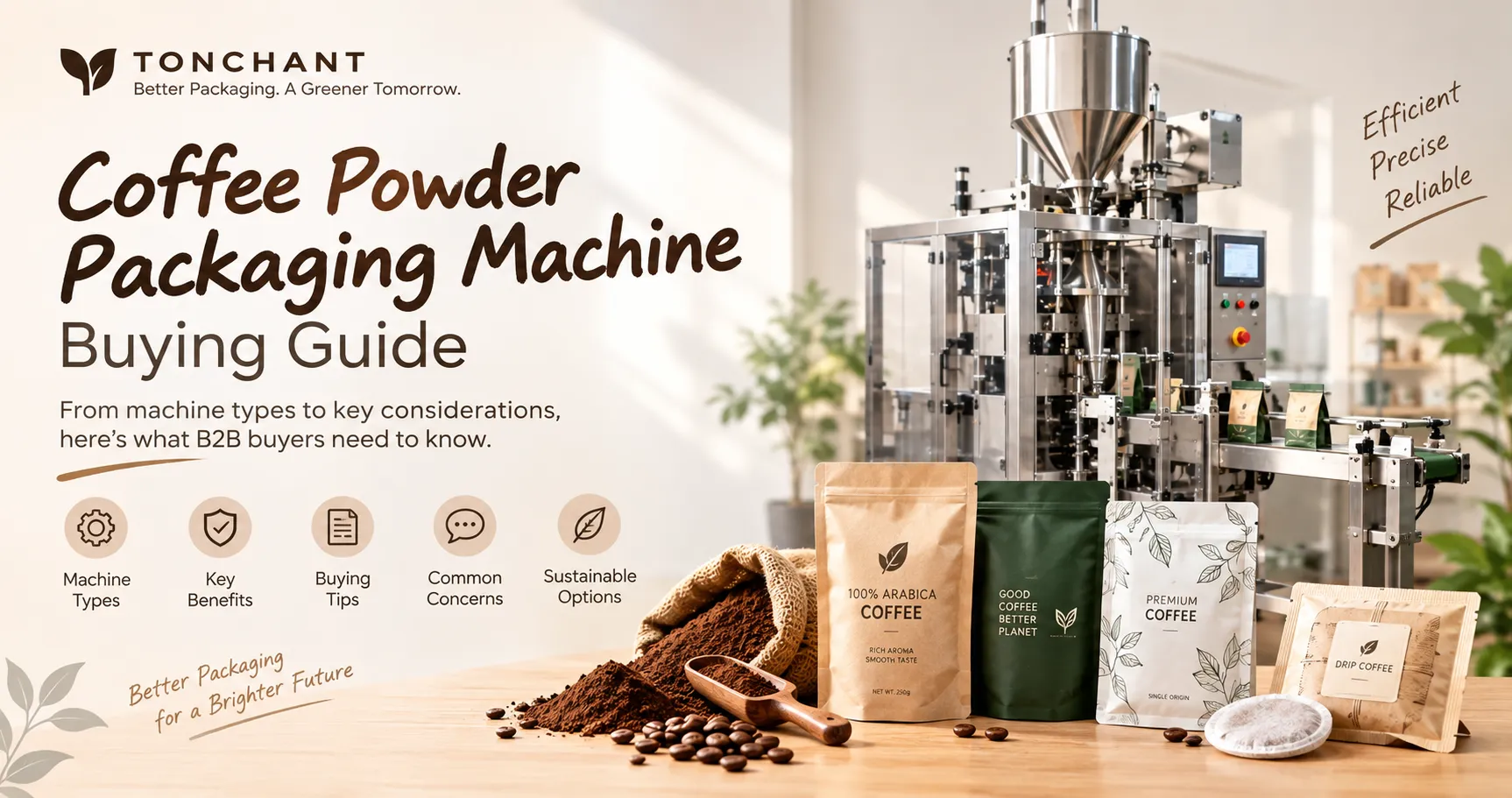
A coffee powder packaging machine is designed to measure, fill, and package ground coffee into a specific format. Depending on the machine, the system may also form bags, seal them, cut them, add production codes, and move finished packages to the next stage.
A typical process might look like this:
Coffee feeding → dosing/filling → bag forming → sealing → cutting → finished package
The exact setup depends on the product.
A standard retail coffee pouch, for example, may be handled by a vertical form-fill-seal system. A premade pouch requires a different feeding and sealing arrangement. Single-serve drip coffee bags need yet another process because the machine must work with filter paper or nonwoven material, portion the coffee, and seal the filter bag correctly.
This distinction is important when sourcing machinery. Buyers sometimes search for a “coffee powder filling machine” when what they actually need is a complete automated packaging line.
Common machine options
| Machine Type | Main Function | Typical Buyer |
|---|---|---|
| Semi-automatic filling machine | Doses and fills coffee with operator assistance | Small roasters and startups |
| Automatic coffee powder packing machine | Filling, forming and sealing | Medium to large producers |
| Premade pouch machine | Fills and seals prepared bags | Brands using custom-printed pouches |
| Vertical packaging machine | Forms and seals bags from roll film | Retail coffee producers |
| Multi-lane packaging system | Produces several packages simultaneously | High-volume manufacturers |
| Specialty drip coffee equipment | Fills and packages individual drip bags | Single-serve coffee brands |
The right choice starts with the package you want to produce, not the machine you happen to see in a supplier's catalog.
Key Benefits
More consistent filling
When coffee is packed manually, even experienced operators can produce variations in net weight. That may not seem significant on one bag, but the numbers add up quickly at commercial scale.
Imagine a distributor packing 200,000 bags a month. If every bag is slightly overfilled, the business is effectively giving away additional coffee without charging for it.
A properly configured filling system helps maintain more consistent weights and gives the production team better control over material usage.
Less repetitive manual work
Packing coffee manually takes more labor than many businesses initially expect.
An operator may need to weigh the coffee, fill the bag, clean the opening, seal it, check the weight, and repeat the process thousands of times. As order volumes increase, packaging can become the bottleneck even when roasting capacity is sufficient.
Automation moves much of that repetitive work to the machine. Operators can instead focus on material loading, quality checks, adjustments, and production monitoring.
More reliable sealing
Coffee packaging needs a dependable seal.
A poor seal can allow oxygen or moisture into the package, while loose coffee particles caught in the sealing area can also create problems. Automatic equipment gives manufacturers greater control over sealing temperature, pressure, timing, and other parameters.
The machine alone, however, does not guarantee a perfect seal. Film structure, material thickness, coffee dust, and machine settings all matter.
Easier scaling
A coffee business may start with a few thousand bags per month and eventually reach hundreds of thousands.
Choosing equipment with a suitable production range can make that transition much easier. Some systems can also be integrated with checkweighers, coding machines, conveyors, nitrogen flushing, or other equipment as production requirements grow.
Better consistency across multiple locations
For restaurant chains and food-service companies, consistency is particularly valuable.
A central facility can use the same filling parameters and packaging specifications for coffee distributed to multiple restaurants or delivery locations. This reduces variation caused by different employees or different manual packing methods.
Applications
Specialty coffee roasters
A growing specialty roaster is a good example of when packaging automation becomes worthwhile.
Suppose a roaster starts by supplying 10 local cafés. Manual packing may be perfectly manageable. Six months later, the business adds online sales and several wholesale customers. Suddenly, employees are spending a large part of the day packing instead of roasting, quality checking, or preparing orders.
At that point, a semi-automatic or automatic coffee powder packaging system may make more sense.
Restaurant chains
Large restaurant groups often need standardized coffee portions for multiple locations.
A central production facility might package 250 g retail bags, 500 g food-service bags, or smaller portions for beverage preparation. The machine should therefore be able to handle the required filling range without excessive changeover time.
For this type of buyer, uptime and repeatability are often more important than achieving the absolute maximum advertised speed.
Food delivery businesses
Food delivery companies may include coffee in breakfast kits, hotel-style packages, subscription boxes, or ready-to-use beverage sets.
Here, packaging flexibility can be more useful than extremely high throughput. A company may need several package sizes while still maintaining relatively modest monthly volumes.
Distributors and wholesalers
Distributors face a different problem: their customers are not always consistent.
One customer may want a 100 g pouch, another a 250 g bag, and a third may need a larger food-service package. Packaging equipment with a reasonable adjustment range can therefore be a better investment than a machine designed around one fixed SKU.
Sustainable coffee packaging
Sustainability is also becoming part of the machinery discussion.
A coffee brand may want recyclable, compostable, or reduced-material packaging, but the packaging material still needs to run reliably through the production line.
For projects involving Tonchant Earth, it is useful to evaluate the material and the machine together. A sustainable film can have different feeding, forming, and heat-sealing characteristics from a conventional laminated structure.
The environmental claim is only part of the equation. The packaging also needs to work in real production.
Buying Guide
1. Start with your coffee, not the machine
Before contacting a supplier, collect as much information about the coffee as possible.
At minimum, prepare:
| Specification | Example |
|---|---|
| Product | Ground coffee |
| Grind size | Fine / medium / coarse |
| Bulk density | Supplier test data |
| Filling weight | 10 g / 250 g / 500 g |
| Monthly volume | 100,000 bags |
| Package format | Pouch / sachet / drip bag |
| Film structure | Customer-specified material |
| Target speed | Packages per minute |
| Required accuracy | Target filling tolerance |
This information can dramatically improve the accuracy of a machinery quotation.
At Tonchant's factory, product and packaging specifications are normally considered together when discussing packaging equipment. Coffee powders do not all behave the same way, so testing the actual product is much more useful than relying entirely on catalog specifications.
2. Decide how much automation you really need
More automation is not automatically better.
A startup producing 10,000 bags a month may not benefit from buying equipment designed for several million bags. The machine could spend much of its working life underutilized.
On the other hand, a large distributor with several shifts may quickly find a semi-automatic system too slow.
| Consideration | Semi-Automatic | Automatic |
|---|---|---|
| Initial investment | Lower | Higher |
| Labor requirement | Higher | Lower |
| Production volume | Small–medium | Medium–high |
| Changeover flexibility | Often good | Depends on machine |
| Operator involvement | More | Less |
| Best suited to | Growing businesses | Established production lines |
The practical question is not “Which machine is better?”
It is “Which machine gives us the right cost per package at our expected production volume?”
3. Check the filling system carefully
The filling mechanism is one of the most important parts of coffee packaging equipment.
Ask the supplier:
-
What filling method is used?
-
What weight range can it handle?
-
What accuracy can be achieved with my coffee?
-
Does filling accuracy change at higher speeds?
-
How often does calibration need to be performed?
-
How easy is cleaning?
-
Can the system handle different coffee densities?
For a coffee powder filling machine, actual testing is preferable to simply accepting a theoretical accuracy figure.
If possible, send a representative coffee sample to the supplier and request a filling test.
4. Consider package dimensions and changeovers
A machine may technically support several bag sizes, but that does not mean switching between them will be quick.
Ask about:
-
Minimum and maximum bag dimensions
-
Filling weight range
-
Film width
-
Changeover time
-
Required tooling
-
Number of operators needed
-
Whether different forming components are required
For a distributor handling many SKUs, a slightly slower machine with easier changeovers may be more productive over the course of a month than a high-speed machine that takes a long time to reconfigure.
5. Don't overlook packaging material compatibility
This is one of the most common sourcing mistakes.
A buyer may finalize a machine first and only later discover that the preferred packaging film requires different sealing temperatures or feeding conditions.
Before ordering, provide the supplier with the actual film structure if possible.
For sustainable packaging, this step becomes even more important. Materials marketed as recyclable or compostable are not necessarily identical in mechanical or thermal behavior.
Tonchant's experience with coffee and food packaging has shown that packaging design and machinery selection are best discussed as one project rather than two separate purchases.
6. Understand MOQ before finalizing customization
MOQ can affect both the machine project and the packaging project.
For printed bags, special materials, custom structures, and unusual dimensions, suppliers may require higher minimum order quantities. If a buyer has five SKUs but each sells in relatively small volumes, ordering separate customized materials for every SKU may create unnecessary inventory.
A practical approach is to identify:
-
Core high-volume SKUs
-
Seasonal products
-
Trial products
-
Expected annual demand
-
Custom packaging MOQ
-
Standard material alternatives
For a new coffee brand, it can be more sensible to begin with a limited number of package formats and expand once sales become predictable.
7. Review customization options
Customization can involve much more than printing a logo on the package.
Depending on the project, buyers may request:
-
Different filling weights
-
Multiple bag sizes
-
Special hopper capacity
-
Different filling components
-
Nitrogen flushing
-
Date and batch coding
-
Checkweighing
-
Automatic rejection
-
Dust collection
-
Conveyors
-
Customized electrical specifications
-
Additional safety features
When comparing supplier quotations, make sure you are comparing equivalent configurations.
A machine with a lower headline price may simply exclude functions that another supplier has already included.
8. Check certifications and destination-market requirements
Certification requirements should be discussed before production starts.
Depending on the destination and machine configuration, buyers may need to consider requirements related to:
-
CE
-
Electrical safety
-
Food-contact components
-
Material compliance
-
Documentation for imported equipment
-
Local electrical standards
The machine and packaging materials should also be considered separately from a compliance perspective.
For example, an importer selling coffee in Europe may have different documentation requirements from a distributor serving the U.S. market.
Ask the supplier what documentation will be provided and confirm what your local regulations require.
9. Think about service after delivery
For overseas machinery buyers, after-sales support is not a minor detail.
A machine can be well built, but production can still stop if an operator cannot solve a basic fault or a replacement part takes weeks to arrive.
Before placing an order, ask:
Is remote commissioning available?
Will operators receive training?
Are manuals and electrical diagrams included?
Which spare parts should be purchased with the machine?
How quickly can replacement components be supplied?
Can the supplier provide troubleshooting support online?
These questions are particularly important for distributors purchasing equipment for customers in another country.
Common Buyer Concerns
“I don't know my exact production volume yet.”
This is common with new brands.
If sales forecasts are uncertain, avoid buying equipment based on the most optimistic scenario. Start with realistic production estimates and calculate the required output per shift.
You can always discuss future expansion with the supplier.
“I need several different bag sizes.”
Check the actual changeover procedure rather than simply asking whether the machine supports multiple sizes.
For a business with many SKUs, changeover time can have a surprisingly large effect on total production efficiency.
“My coffee creates a lot of dust.”
Fine coffee particles can interfere with sealing and make the packaging area difficult to keep clean.
Ask about dust-control measures and whether the filling system can be tested with your coffee. A clean sealing area is essential for consistent package quality.
“I want to use sustainable packaging.”
Discuss this before purchasing either the film or the machine.
A sustainable packaging structure should be tested under actual operating conditions, including feeding, forming, sealing, and speed.
For Tonchant Earth projects, material selection and equipment compatibility should ideally be evaluated at the same stage.
“The supplier's machine is cheaper.”
Look beyond the machine price.
Compare the full specification, including tooling, installation, coding equipment, conveyors, spare parts, shipping, commissioning, and after-sales support.
The cheapest quotation is not necessarily the lowest total cost of ownership.
FAQ
1. What is the difference between a coffee powder packing machine and a coffee powder filling machine?
A coffee powder filling machine primarily measures and dispenses coffee powder. A complete coffee powder packing machine can include filling, bag forming, sealing, cutting, coding, and product discharge.
2. How do I choose the right coffee powder packaging machine?
Start with the coffee itself, filling weight, package format, production volume, packaging material, required speed, and automation level. These details should be defined before comparing machine models.
3. Can one machine handle different coffee bag sizes?
Many machines can accommodate several sizes within a specified range. However, changing dimensions may require machine adjustments or different forming components. Always ask for the exact supported dimensions and expected changeover time.
4. What information should I send when requesting a quotation?
Provide the coffee type, grind characteristics, filling weights, package dimensions, packaging material, expected monthly volume, target production speed, destination country, and any special requirements.
If possible, provide product and packaging samples for testing.
5. Can a coffee powder packaging machine work with sustainable packaging?
Yes, depending on the material.
Recyclable, compostable, and other sustainable films can have different feeding and sealing characteristics. The actual material should be tested on the proposed equipment before mass production.
Conclusion
Choosing a coffee powder packaging machine is ultimately about finding the right balance between capacity, accuracy, flexibility, labor, packaging materials, and long-term operating cost.
For a small roaster, that might mean starting with a practical semi-automatic system. For a restaurant chain or large distributor, consistent output and automation may justify a more advanced line. For a sustainability-focused brand, material compatibility should be part of the machinery discussion from the beginning.
Real production conditions matter, too. Coffee density changes. Packaging films behave differently. Orders fluctuate. Seasonal products appear. A machine that looks perfect on paper still needs to perform with the actual coffee and packaging the business intends to use.
That is why a good sourcing process should include product testing, clear specifications, transparent MOQ information, customization details, certification requirements, and a realistic discussion of after-sales service.
At Tonchant, machinery and packaging are often evaluated together because the two directly affect each other. Whether the project involves conventional retail coffee bags, single-serve formats, or Tonchant Earth sustainable packaging solutions, testing the complete process before mass production can prevent expensive surprises later.
The goal is not simply to buy a faster coffee powder packing machine. It is to build a packaging process that remains reliable as the business grows.